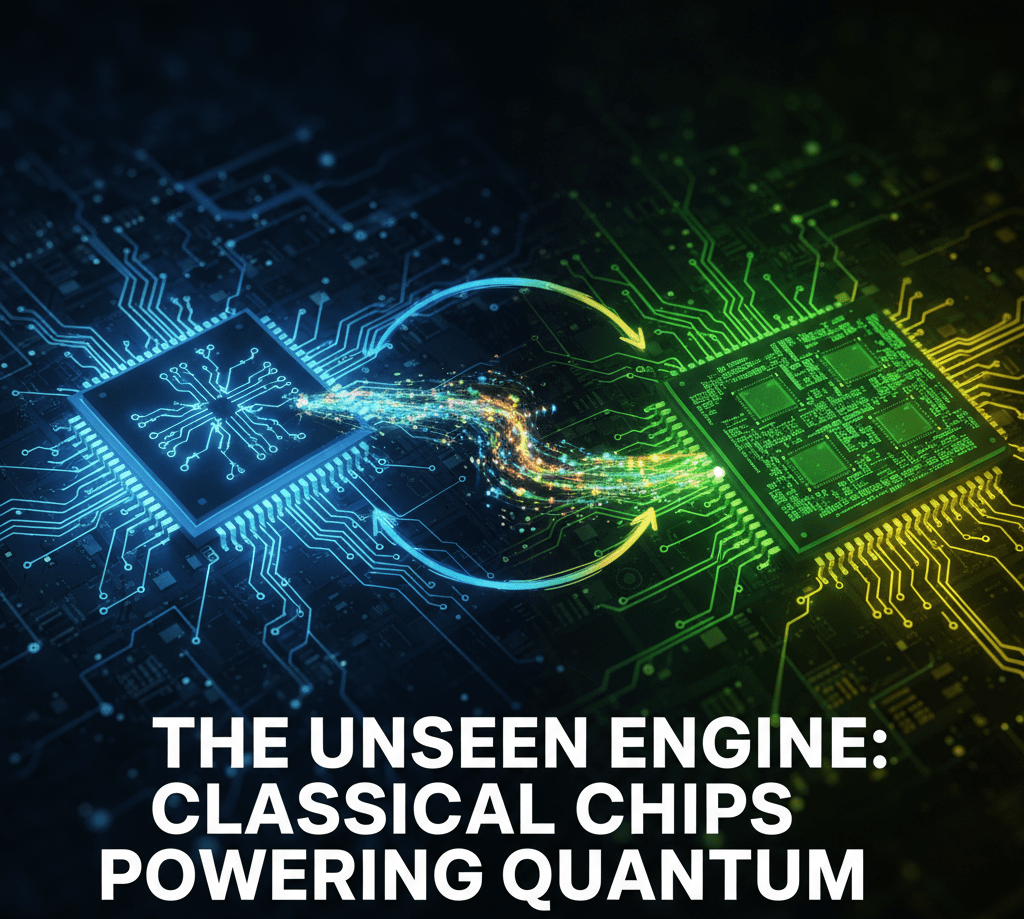
IBM’s recent milestone using off-the-shelf AMD hardware reveals a critical truth: the race for quantum supremacy is as much about high-speed classical engineering as it is about exotic physics. This hybrid approach is not just accelerating the quantum roadmap; it’s forging a new class of technology that could soon benefit industries far beyond computing.
In the grand narrative of quantum computing, it is the quantum processing unit (QPU)—with its arcane qubits and cryogenic chambers—that captures the imagination. Yet, a recent announcement from IBM has shifted the spotlight to an often-overlooked, but equally critical, component: the classical hardware that acts as the QPU’s life-support system.
IBM is reportedly running a sophisticated, real-time quantum error correction algorithm not on a bespoke, multi-million-pound piece of custom electronics, but on a commercial, off-the-shelf Field-Programmable Gate Array (FPGA) from AMD.
This may sound like a minor engineering update, but its implications are profound. It signals a move towards standardisation and cost-reduction that could democratise quantum development. More importantly, it validates a crucial development path for the classical “control plane” required to manage the immense fragility of quantum states. This news provides a perfect window into the hybrid, classical-quantum architecture that will define the future of computing.
The Quantum Computer’s Classical “Life Support”
A QPU is an object of profound instability. Its qubits—the quantum equivalent of classical bits—exist in a delicate superposition of states. This state, known as coherence, is where the quantum magic happens. Unfortunately, it is fleeting. The slightest noise, vibration, or thermal fluctuation can cause a qubit to “decohere” and lose its quantum information, often in microseconds or even nanoseconds .
This fragility is the single greatest obstacle to building a useful quantum computer. The solution is Quantum Error Correction (QEC).
QEC is a constant, high-stakes dialogue between the quantum chip and a classical control system. The classical system must:
- Poll the QPU for “error syndromes,” which are tiny signals that hint an error is about to occur.
- Process this massive stream of syndrome data in real-time.
- Calculate the precise corrective action needed.
- Send a corrective microwave pulse back to the specific qubit.
All of this must happen before the qubit decoheres. The classical system is locked in a race against physics, and it must win, millions of times per second, across thousands of qubits. A standard Central Processing Unit (CPU) in a laptop or server is hopelessly outmatched. It operates on a timescale of milliseconds and is designed for sequential tasks, not the massively parallel, low-latency challenge that QEC presents.
This is where specialised classical hardware comes in.
FPGAs and ASICs: The Two-Step Path to Fault-Tolerance
IBM’s work validates a two-stage development pipeline that is rapidly becoming the industry standard for building the quantum control plane.
The “Now”: FPGAs for Prototyping
A Field-Programmable Gate Array (FPGA) is, in essence, a blank slate of digital logic. Unlike a CPU, its internal pathways are not fixed. An engineer can reconfigure the chip at a hardware level to perform a specific task, bypassing the bottlenecks of software.
FPGAs are the perfect tool for the current R&D phase of quantum computing for two reasons:
- Reconfigurability: The science of QEC is still being written. The best algorithms have not been finalised. An FPGA allows researchers at IBM and elsewhere to test a new error correction code in the morning, find a bug, and upload a new hardware design in the afternoon.
- Low Latency: Because the logic is “burned” directly into the hardware, an FPGA can execute the “detect -> calculate -> correct” loop within the microsecond-scale decoherence window.
IBM’s use of a commercial AMD chip proves that this essential prototyping work no longer requires fantastically expensive, custom-built hardware. It opens the door for universities and start-ups to contribute, accelerating the entire field.
The “Future”: ASICs for Scale
While FPGAs are flexible, they are a stepping stone. As we move from today’s noisy, intermediate-scale quantum (NISQ) devices to truly Fault-Tolerant Quantum Computing (FTQC), the classical processing demands will become astronomical. A full-scale system will need to process terabytes of error syndrome data per second with unwavering, sub-microsecond latency.
FPGAs are not optimised enough for this. They are too large and, crucially, too power-hungry. You cannot place thousands of power-hungry FPGAs next to a QPU operating near absolute zero.
The solution is the Application-Specific Integrated Circuit (ASIC).
An ASIC is a chip “hard-wired” at the factory to do one single task. The QEC algorithm, once perfected on an FPGA, is permanently etched into the silicon. What you lose in flexibility, you gain in brute force. An ASIC designed for QEC will be exponentially:
- Faster: With logic paths optimised to the atomic level for one job.
- Smaller: Allowing for tighter integration with the QPU.
- More Power-Efficient: This is the most critical factor for scaling.
The journey is therefore clear: Research on CPUs -> Prototype on FPGAs -> Deploy at Scale on ASICs. The IBM/AMD news is a powerful confirmation that the industry is firmly and successfully on the second stage of this journey.
The ‘Quantum-Ready’ By-Products for Global Industry
This relentless push for a classical quantum control plane is creating a family of “spin-off” technologies. To solve the QEC problem, engineers are being forced to solve one of the hardest problems in classical computer science: ultra-low-latency processing of massive, parallel data streams.
The resulting hardware architectures and algorithms, developed long before a universal quantum computer exists, will have direct applications across major global industries.
1. 6G Telecommunications and Advanced Radar
The next generation of wireless communication (6G) and phased-array radar systems will rely on “beamforming”—instantly processing signals from thousands of tiny antennas to aim a data stream or radar pulse. This requires fusing and processing enormous data streams with microsecond latency. The FPGA/ASIC control systems being designed for QEC are, functionally, an extreme version of this exact problem.
2. High-Frequency Trading (HFT)
In quantitative finance, fortunes are decided by nanoseconds. The time it takes to parse market data, run a prediction algorithm, and execute a trade is a critical competitive advantage. The hardware being perfected to read quantum error syndromes is an ideal platform for HFT algorithms, offering a new generation of speed that software alone cannot provide.
3. ‘Edge’ AI and Autonomous Systems
A self-driving car cannot afford to send its LIDAR and camera data to the cloud for analysis. It must identify a pedestrian and apply the brakes in milliseconds. This is “AI at the edge.” The compact, power-efficient, and fast-twitch reflex of a QEC-inspired ASIC is the perfect processing engine for this kind of real-time sensor fusion and instantaneous decision-making in autonomous vehicles, robotics, and drones.
4. Scientific Instrumentation
Particle accelerators like the Large Hadron Collider (LHC) at CERN generate petabytes of collision data per second. Most of this is “noise.” These facilities use massive, complex “triggers”—systems of FPGAs—to sift this data torrent in real-time and decide what tiny fraction is interesting enough to save. The work on QEC syndrome processing is, in effect, developing the next-generation trigger technology for all large-scale physics and radio astronomy experiments.
A Hybrid Future, Built by All Engineers
The IBM-AMD demonstration is a powerful reminder that the quantum computer is not a single, magical device. It is a deeply hybrid system where the “quantum” part is entirely dependent on its classical counterpart.
The pursuit of the QPU is forcing a golden age of innovation in classical digital design. The quantum revolution is not just being built by quantum physicists in lab coats; it is being built by the VLSI, FPGA, and systems engineers solving some of the most challenging data-processing problems ever conceived.
In the end, the road to fault-tolerant quantum computing is paved with classical innovations—and those innovations may well change our world long before the first true quantum computer comes online.
Subscribe to our newsletter for regular updates on the AI, HPC and Quantum insights !


 IAORA42
Leave a comment